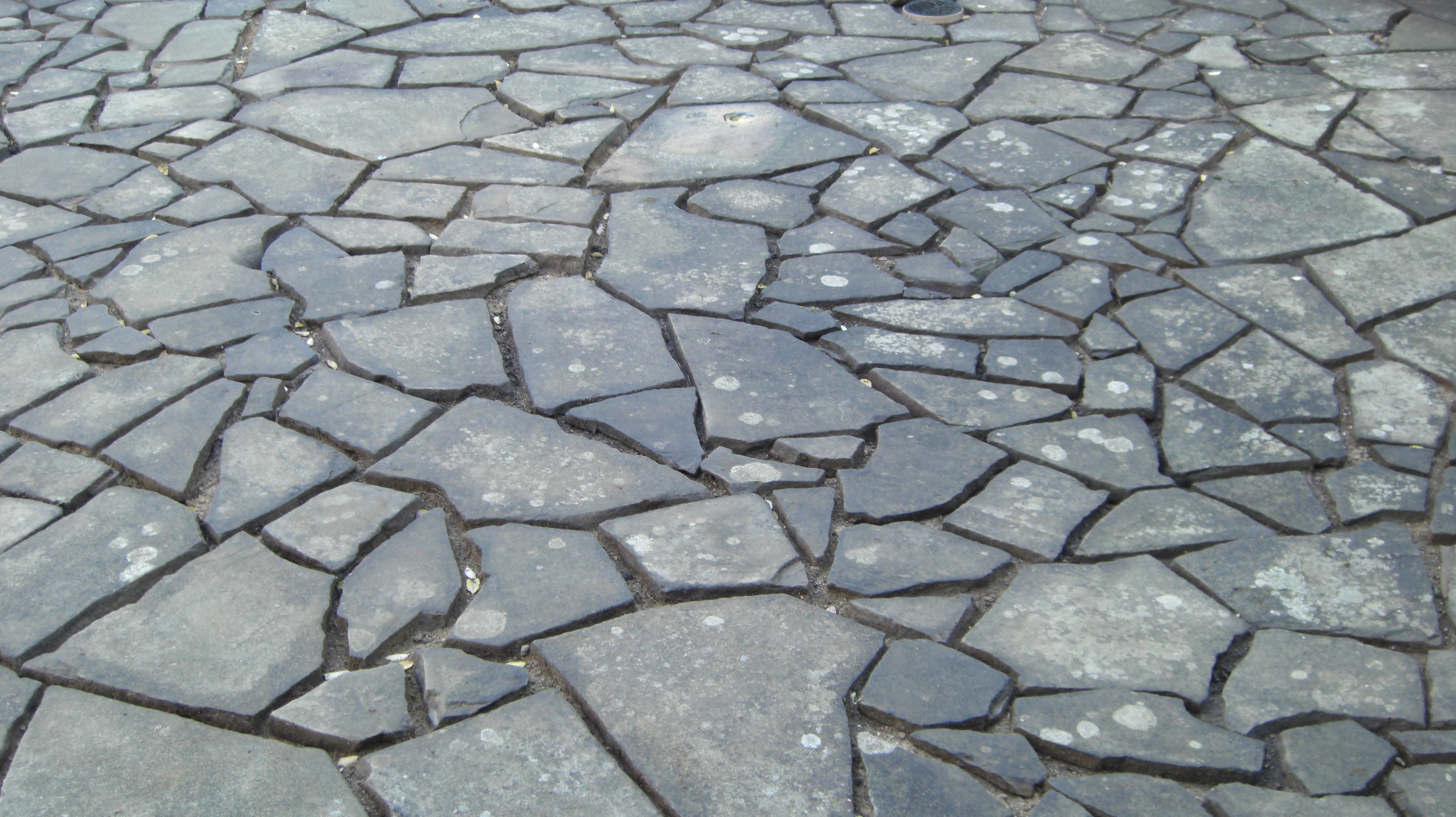
A stone patio with irregular flagstone installation showing typical joint widths and surface variation. Consistent joint depth and appropriate jointing material are critical in frost-prone climates. Photo: Bumper12 / CC BY-SA 4.0 / Wikimedia Commons
Why Jointing Material Matters Under Frost
When stone surfaces experience minor frost heave — even with a well-constructed sub-base, small vertical movements occur at the millimetre scale — rigid jointing materials crack and allow water infiltration. Once water enters through joint cracks, it accumulates beneath the stone, and the next freeze cycle expands that water, widening the breach further. Over several seasons, a rigid mortar joint in a Canadian outdoor installation will typically fail.
Flexible jointing materials accommodate small movements by compressing and releasing rather than fracturing. This makes them significantly better suited to the conditions found in most of Canada than traditional cement mortar.
Polymeric Sand
Polymeric sand is a dry blend of graded sand and polymer binders. After installation, the material is activated with water, which causes the binders to set, producing a semi-rigid joint that resists erosion, weed growth, and ant disruption while remaining flexible enough to accommodate frost movement. It is currently the most widely used jointing material for residential stone installations in Canada.
Application process
- Ensure the stone surface is completely dry before application.
- Pour dry polymeric sand over the installation and spread it with a broom, working it into the joints from multiple directions.
- Sweep off excess material from stone surfaces, then compact lightly with a plate compactor (place a protective rubber pad between the compactor and the stone).
- Sweep again to remove all surface residue — any remaining sand left on stone faces will be set permanently by the activation step.
- Apply water using a garden hose with a gentle spray setting. Water from above activates the polymers in the joints without washing them out. Do not apply with high pressure or continuous flow.
- Allow to cure for 24 hours before foot traffic and 48–72 hours before heavy use.
Temperature window: Polymeric sand requires air temperatures above 4°C during application and the first 24 hours of curing. Do not apply in late autumn when overnight frost is likely before cure is complete.
Joint width for polymeric sand
Polymeric sand performs best in joints between 5 mm and 25 mm wide, and to a depth of at least 25 mm. Narrower joints do not hold sufficient material to provide weed and erosion resistance. Wider joints — common with irregular flagstone — typically require the material to be tamped more carefully to achieve adequate density throughout the joint depth.
Kiln-Dried Sand
Kiln-dried sand is a fine, dry aggregate used as a simpler, lower-cost alternative to polymeric sand. Unlike polymeric sand, it does not bond — it remains loose in the joint, providing drainage and some weed resistance but no structural cohesion. It is more easily displaced by heavy rain, ant activity, and joint weathering, and requires periodic top-up to maintain joint depth.
For applications where low cost and ease of repair are priorities, kiln-dried sand is a practical choice. It is less appropriate in installations with wide joints (above 15 mm) or in areas with significant ant pressure. It remains a common choice for installations with close-fitting stone where joint widths are under 10 mm.
Dry Mortar Mix (Semi-Dry)
A semi-dry mortar approach — brushing a dry mix of sand and Portland cement into joints, then lightly misting with water — produces a harder set than polymeric sand while still allowing some limited flexibility compared to fully wet-mixed mortar. It is used where a more durable joint appearance is required, such as around steps or formal patio edges.
Semi-dry mortar joints are more susceptible to cracking under significant frost movement than polymeric sand. They are more appropriate in installations with a deeper, well-drained sub-base that limits movement. They are not recommended for wide irregular joints in prairie or northern Quebec installations where frost depth is substantial.
Wet Mortar Joints
Traditional wet mortar — a mixed cement and sand slurry applied to fill joints — produces the hardest, most rigid result. In Canadian outdoor applications subject to frost heave, fully wet-mortared joints in stone installations regularly crack within the first two to three freeze-thaw seasons unless the base is essentially frost-proof (below frost depth entirely, with perfect drainage). This approach is generally not recommended for residential outdoor horizontal stone surfaces in frost-prone Canadian climates without specific engineering input.
Exceptions include applications on concrete slabs with movement joints designed into the slab, or vertical applications (stone cladding, retaining wall caps) where different forces apply.
Laying Patterns and Their Practical Effects
The pattern in which stones are laid affects not only appearance but also structural behaviour, joint alignment, and the likelihood of cracking under load or differential movement.
| Pattern | Description | Frost Performance Notes |
|---|---|---|
| Irregular / random flagging | Stones laid in natural irregular shapes, joints non-linear | Joint widths vary; requires careful jointing material selection. Individual stone movement has less effect on adjacent pieces. |
| Running bond | Rectangular stones with staggered joints (like brickwork) | Long continuous joints in one direction can align with frost crack propagation. 1/3 offset preferred over 1/2. |
| Ashlar (coursed) | Regular rectangular stones in horizontal courses, varied lengths | Good structural performance. Predictable joint widths simplify jointing material selection. |
| Herringbone | Rectangular stones at 45° in V-pattern | Interlocking effect distributes loads well. More cuts required at edges increase edge vulnerability. |
| Opus incertum (crazy paving) | Highly irregular pieces fitted together like puzzle | Many irregular joint widths; requires consistent jointing depth throughout. Edge pieces particularly vulnerable to cracking if thin. |
Edge Restraints
Without a perimeter restraint, stones along the edge of a path or patio can migrate outward over time — gradually widening the installation, allowing central stones to shift, and creating a characteristic spreading effect often seen in poorly installed garden paths.
Edge restraint options for stone paths include:
- Plastic edging stakes: Low-cost option driven into the compacted granular base at the excavation perimeter. Adequate for straight edges on foot-traffic paths.
- Steel edging: More durable and holds precise alignment better than plastic. Preferred for formal patio perimeters.
- Cut stone or soldier course: A row of stones set on end or at reduced spacing at the perimeter, typically mortared into a small concrete haunch. The most durable and attractive option, though the mortar haunch should be below final grade to limit frost exposure.
- Concrete haunch: A poured concrete edge slightly below grade, against which stones are bedded. Effective when well executed but requires forming and curing time.
Joint Depth and Consistency
A consistently maintained joint depth throughout the installation is more important than the specific material choice. Shallow joints — where jointing material fills only the top 10–15 mm with a large void below — wash out quickly, allow weed establishment, and provide inadequate support at stone edges. Joints should be filled to within 3–5 mm of the stone face, with a slightly recessed finish that discourages surface water pooling in the joint.
After the first winter, inspect joints across the installation. Areas where jointing material has washed out or settled indicate either insufficient original depth or a drainage issue beneath. Top-up with the original jointing material where gaps are present before the next freeze season begins.

Paving stone surface showing grain texture. Surface texture affects both traction in icy conditions and the visual depth of joints. Photo: Titus Tscharntke / Public Domain / Wikimedia Commons
Sealing Natural Stone in Frost Climates
Stone sealers can reduce water absorption and improve freeze-thaw resistance for stone types that are borderline in terms of porosity. For granite and quartzite, sealing is optional and primarily cosmetic. For limestone and sandstone, a penetrating, breathable silicone or siloxane-based sealer can meaningfully reduce moisture uptake.
Sealers should be applied only to clean, dry stone. In Canada, autumn application before freeze-up allows a full cure before the stone is exposed to winter conditions. Avoid film-forming sealers (topical coatings) on exterior stone — these trap moisture beneath the film, accelerating the freeze-thaw damage they are intended to prevent. Only use penetrating, breathable sealers on exterior horizontal stone surfaces.